
This is the sixth in my series of articles for the absolute chess beginner. In this article, we’ll see how the chess pawns move and capture.
The Pawn in Chess
The pawn is the foot-soldier of chess. Each side has 8 pawns, and they start the game lined up in front of the more powerful “officers” of the chessboard. Although the pawn is the “weakest” of the chess pieces, each pawn is very important; the loss of even a single pawn without compensation may mean the loss of the game! And by advancing to the other side of the chessboard, the pawn may become the most powerful piece on the board! (See my article on pawn promotion.)
Normal pawn movement
The pawn normally moves one space vertically, i.e., “up” the board, toward your opponent’s first rank. The pawn never moves horizontally (i.e., from side to side) and never moves backward. If the pawn moves forward and meets another pawn or piece, it’s movement is blocked until the other piece is moved or captured.
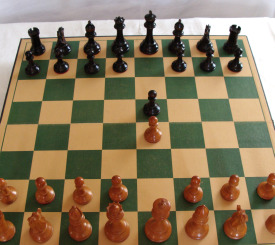
Very often one pawn from each side will meet in the middle of the board and block each other’s movement. Unlike the other chess pieces, the pawn does not capture enemy pawns or pieces that obstruct its normal movement; if the pawn’s normal movement is obstructed, the pawn is effectively stopped in its tracks.
Normal pawn captures
Although the pawn does not capture if its normal movement is blocked, it can capture. The pawn captures ahead one square diagonally.
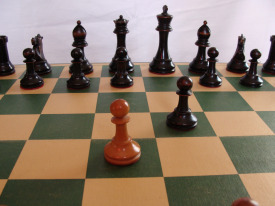
(The pawn never captures “backward” diagonally.) The pawn may capture any enemy piece (even the Queen!) that dares to stand one square diagonally from the pawn.
The initial two-square move
The first time that you move each of your pawns, you may move it ahead two square instead of one. This is optional; you may also move your pawns ahead one square on its initial move. This option only applies to the first move of each of your pawns, but it does apply to the first move of each of your pawns. Thus, you may make 8 two-square moves, one for each pawn.
If you’re interested in learning the basics of chess, I recommend Learn Chess: A Complete Course, which will teach you all about the fundamentals of good chess play. If you’re interested in some more advanced material on the pawn, I highly recommend Pawn Power in Chess, one of the great classic books on chess strategy! It will teach you about pawn structure in chess and how the other pieces depend on and use the pawns to their advantage.
Look for the next article in this series, about the “special” chess moves, including pawn promotion and the “en passant” pawn capture.
Dear Sir,
I have a doubt is it possible the soldier pawn can jump at the end ,2 steps if he has not made the 2 steps move in the beginning of the game.
Awaiting your reply
No Sudheesh, the pawn can only make the two-step move on its first move.
Keep in mind that each of the 8 pawns can make a two-step move the first time each of those pawns move.
But after a pawn has moved, it can only move one square at a time from then on.
What is the pawn move labeled in French and allows a pawn to take a pawn by passing and not a diagonal capture?
I think you refer to the en passant capture. You can read about that weird pawn capture here. The en passant pawn capture.
Hi:
I’m trying do develop a title to a novel and I am seeking the name of a chess strategy, (if there is one)that the entire game is planned with secret undetected moves right up to the final check mate?
Chess is a game of perfect information. The opponent sees everything that the player sees — other than what’s in the player’s head, of course. There is no “secret strategy” that can be sprung on a player that could not also be divined by the player before it’s too late. A plan might be unknown to the opponent until it’s too late, but that would involve faulty planning or lack of chess knowledge. Usually a good player will detect his opponent’s plans before they can be fully executed. It happens very often that a player is caught by surprise by a “mate in one,” (how about that for a title?), but that is never a game-long strategy. It usually comes up by serendipity as the game progresses.
Thanks for your comment!
I have a question about the pawn. Can a pawn capture another piece diagonally its first move?
Yes it can, and this occurs very often. Thanks for your question!
I was playing a game with a new friend and we had an issue. I’m wondering if you can clear it up. On a pawns first move, it is allowed to move either one or two ranks. If I choose to use the two rank method can I kill a piece? I’m sure that it is allowed but I need a second opinion.
The pawn can only capture by moving one square diagonally. You can’t capture a piece by moving a pawn forward two squares (or one square). Of course, you may capture using that pawn on the next move (or any subsequent move).
I hope that answers your question.
Awesome question: can a pawn simultaneously capture diagonally, landing on the eighth row, and be promoted all as one move?
Yes indeed! 🙂
Hello!
I am a beginner at chess and I am finding your explanations very helpful!
I am a bit intimidated because I don’t think I will be fast during the game!
Thanks so much for all your help!
Estelle
Ok so I was playing chess on the chess free app for iOS on its hardest difficulty and in the advanced stages of the game the computer has his pawn on the sixth rank then capture my piece on the seventh rank….. Two squares away. It acted like a knight. I undid the move and instead THE PAWN took a piece the same way but in the opposite direction. I undid the move again and he still did it, what the hell happened!?
It went from d3 to f2 and d3 to b2
Boy … I’d have to see that to believe it, or even to understand what happened. Suffice to say that what you described is illegal, (the pawn never moves like a knight), and it may very well be a glitch in the app. I’d ask the app developer. Please bear in mind that some beginners think that the “en passant” capture by a pawn is illegal or a computer glitch: it’s not.
Can a Pawn move up two paces on its first move, and the second space be diagonally for a capture?
No. The initial two-step move by a pawn can never be a capture. It can, of course, make a capture on its first move, but only one square ahead diagonally. The pawn can never capture an enemy pawn or piece that is more than one square away.
Does a pawn HAVE to capture the other pawn when given the chance or can you choose to do another move and ignore the fact that their pawn is there for the taking?
Captures are not mandatory, as they are in checkers. The pawn does not HAVE to capture the other pawn (or other piece); you can ignore the possible capture and choose to make another move.
CAVEAT: if a capture is required to get a player’s king out of check, then the capture is required.
Hi,
Please clear me whether Pawn can capture diagonally backward???
The pawn never moves backward and does not capture diagonally backward.
Thanks for your question!
Hi, can the pawn move forward even if it has a capture option? Imagine white on c4, and black pawn on d5. Can the white pawn move forward instead of capture?
In that case, the pawn may either capture the black pawn on d5 or move to c5 (assuming, of course, that the c5 square is empty).
hello,please clarify my doubt
I HAD MOVED MY BLACK PAWN TO “C5”,POSITION & IN THE COUNTER MOVE COMPUTER(I WAS PLAYING WITH IT),KILLED THIS PAWN BY MAKING A “DXC6”,MOVE,I FAIL TO UNDERSTAND WHEN I AM NOT AT C6,HOW CAN MY PAWN BE KILLED?
can a pawn at c5 ,position be killed by opponent pawn’s ‘dxc6’move?
Can a pawn capture the opponent straight when it reaches the fifth house?
Waiting for reply as early as possible